Friday, September 20, 2013

More pictures from Mongolia

The living room of a lady that was taking care of one of our water points.

This lady had kept her kiosk clean--she even had a sofa to sit on.  They all have to be heated so that they don't freeze in the winter.

Jim, Mugi, & Elder & Sister Nay--having one of our 'lunchder's (late lunch, early dinner).
Crumbling mortar on a kiosk.
We found some with broken windows--kids, maybe?
The sign used on our kiosks.


They wanted us to put a dump station in this spot, and it was the more feasible place to put one--we thought it might crumble like this shack did.  It was also at the top of a hill.
I always had thought of Yak's as this pretty animal.  Up close and personal they disappointingly a little dirty! (above & below).


This pretty building is connected to a park (below).

There is an elephant statue in the park--they and some other animals are quite revered.  
A plaque on the side of one of our kiosks--this is showing who the contractor was.  If I were him, I might not have put it on the building as the construction was not all that good.


The fascia boards were inferior on all buildings and some parts of them were missing.


The Impossible Dream

Thursday, September 19, 2013

We woke up to rains that had just finished for the day, but the temperature had dropped yet another 10 degrees and the sun hid much of the time behind the clouds.  It would not have been so bad except for where we traveled.  First we met with some government people that wanted to show us their proposed projects in the areas where they have been elected to serve the people.  There are Districts, and these are divided into Harrows.  (They pronounce the ‘H’ with a guttural sound.)  We had a rented car with a driver today because there is no place to park where we met with these people.  With us this day was a young man who would be ‘leading this parade’.  I call it a parade because we would stop and pick up two politicians, drive to where they wanted us to put a dump station, drop them off and then pick up another set of politicians. 

You might call our day one of ‘pipe dreams’.  They each took us to areas where no one else would do a water project.  After seeing the sites, I began thinking of the song, ‘The Impossible Dream.’  There were two problems with all of them: (1) they were too high up on the hill (these were all located in suburbs just out of the main city) to do a borehole—who knows how long you’d have to drill to reach any water—probably to China; (2) the dirt roads were too steep and become impassable in the wintertime by a water truck that would be dumping his load into the tank.  The water truck people had already been to see these areas and told them that they would not drive their trucks up there.  The politicians (hopeful little souls) thought that we could simply build them a good road so that the trucks could get up there.  We don’t do roads, but told them that if they wanted to partner with us, they could make sure the roads stayed level and bladed so that it might be possible for a truck to get up there without tipping over as it sloshed along.  However, we know what the government does.  After the government bladed it once and everyone was happy, the following year they would ‘forget’ to do it.  Then the expense of these new water stations would go to waste.  And, some places were a bit steep and we’re still not sure if any water truck would venture to go there.

This picture does not begin to capture the spectacular views from the top of the hill to the suburbs and down to UB.


As we stood on top of these hills in the icy wind, we were all freezing, even Mugi who was born here.  I brought out my stocking hat and gloves that I’d packed (Jim smiling at me when I was packing, telling me I’d never need them) and was the warmest person standing on those hills.  The views were absolutely spectacular—you could see everything from there.  We thought how wonderful it would be to live here in the summertime…but now?  I can’t imagine what it would be like when it gets 40 below.

There are steam smokestacks that are used to power the entire city.   

Afterwards we ate our usual too late lunch, too early dinner—you’ve heard of brunch, but have you heard of ‘lunchder’?   We have one every day.  Then we called it a day.


Interesting facts: *don’t put your purse, backpack, briefcase, or important papers on the floor.  It is culturally not proper—it has something to do with putting a part of yourself on the floor and disrespecting yourself.  *Trash cleanup is fairly good in Mongolia.  Mugi says that she puts her trash out once a month and the trash truck picks it up.  During our travels yesterday we saw a landfill area for trash.  The first day we visited a dump station site we noticed these ladies from some environmental group picking up trash along the road.  We visited a site where our church contracted with a group to remove a giant pile of trash—they completed one area but not another.   *A street sweeper here is a man with a broom.  We noticed them out after the rains had stopped, sweeping up the grit in the road.  It must be dangerous here since pedestrians never seem to have the right of way.  *In a land full of cows, there must be lots of flies—this has been found to be quite true.  *When you are handed a business card, hotel bill, etc. you often receive it with two hands and a bow.  This seems to be more prevalent in Hong Kong, but we also noticed this at times here in Mongolia—they are, after all, next to China.  *Mongolia is probably one of the sparsest populated countries—it is huge, but as stated before, almost everyone lives in UB.  Several years ago they had one of those extended freezes and it killed most of the animals, which left the people living on remote ranches without food that year.  More and more people are moving closer to the city just to survive; that is why whenever you drive in the city you feel like you’re on the ‘405 parking lot’ (that is what we in Southern CA call one of our freeways).  *To make wool cloth they first wash the wool and then beat it till it becomes thick, wool material.                                   Trash pick up is much better here—they just ‘missed a spot.’


Love, From Mongolia on a chilly day.


Thursday, September 19, 2013

A very long day in Mongolia

Wednesday, September 18, 2013

We woke up to wind and cloudy skies and took a drive that began at 8:30 AM and ended at 8:30 PM.  It began to rain before we reached our destination, but thankfully it never rained very hard.  It took us forever just to get out of the city--about 1½ hrs.  We began our journey on a very nice road, which eventually narrowed and became at times rather bumpy.  Eventually we ended up on dirt, first not so bad, later worse, but mostly not as extreme as what we’ve experienced in the past.  Our goal was to travel to a growing town where we had 4 boreholes, which were covered with roomy kiosks.  There is electricity to pump the water into a plastic tank, and then dispensed easily (no hand pumping) to those who come to purchase it.  The huts have thick walls and a stove to heat the room.  Some even have couches and tables and throw a rug over the cemented floor. 

The best of the constructed kiosks where water is sold.  It is pumped into a tank or directly into their buckets.


First we located the office of the water ministry and met with a woman and several men.  One of these men took us to each of the well sites so that we could be terribly disappointed with several things: (1) poor construction, except at one kiosk or hut; (2) plastic tanks that were full of sediment so that they could not be used and they would pump directly from the pipe into the buyers’ cans; (3) only about 12-20 people ever showed up to any of them to purchase the clean water each day (each person representing about 5 persons per household); (4) the government, who have signed a contract with the church to keep them in good repair and working order, never did anything to fix them.  If they needed something, the person running the kiosk did so.  At least the poor people in charge collected a small amount of money for their trouble, but it was usually only between 80 cents to $1.20 a day because they were also paying for the electricity to pump the water.  It did, however, supply them personally with clean water and a few of their neighbors.  Some had broken windows, warped doors brought about by the extreme climate (it gets 40 below in the wintertime), and of course typical third world mortar between the bricks, inferior fascia boards, twisted and partly missing, paint that peels off the cement walls inside as soon as it is put on (no one seems to know you can’t paint over raw concrete—it just doesn’t stick unless you use a primer), and various other problems.  We wondered if these projects warranted being done in the first place with so few families receiving benefits from the projects.  Many have their own dip wells, but if they need some cleaner water for drinking they use a dump station.  After our look-see, we ate a lunch/dinner at a very nice restaurant with good food and left just before 5 PM.  It rained on us the entire way home, but not hard.  It was still crowded in the city when we returned.
Although this can be rather distressing for all of us, I really enjoyed our drive so that I could see more of the country and learn about things we saw along the way.  One thing is for certain, almost everyone in Mongolia lives in Ulaanbaatar (or as they call it, UB) than anywhere else.  There are huge parcels of land for farming or ranching out of the main city.  They grow wheat and vegetables, potatoes and cabbage.  They mine coal, copper and even diamonds.  We saw herds of cattle, sheep, goats, pigs, horses, yak, and finally found a camel—a friendly little guy wanting to have his picture taken and likely to almost kiss you if not careful.

 We found this friendly camel that loved to have his picture taken.        

         Please don't kiss me!   
                                                  
I saw a man riding his horse fast, dressed in traditional clothes like you see in pictures, but I was unable to get a photo of him.  The hills are mostly barren of anything but grasses, but we also saw many places loaded with trees, some still verdant green but others turning yellow in the cooling climate.  The city we visited did have a growing population, but on our way we only saw a dwelling here or there with fields for growing or for animals to graze; we also saw places with nothing at all except the landscape. 


The interesting countryside: We saw many different kinds of animals grazing--cow, sheep, goats, yak, horses, pigs, etc. all set in a backdrop of green grasses and in many places, trees turning to fall colors.

Something we have found interesting—when we first arrived and every night since then we can see and hear from our window a guy driving his car around in circles in a parking lot, tires squealing loudly as he is traveling rather fast.  He does this for about 30 minutes.  It happens at various times but he is there every night.  Last night he was joined by others and once they even bumped bumpers—go figure!

Interesting facts: *Mongolian men take an interest in and are often seen taking care of their babies—they are so very proud of them (and we ladies are very happy to see this!).  *Mongolians in general love to sing and have beautiful voices.  They are fairly light-skinned, dark haired, often with dark red highlights.  *To try and control traffic, the government issues license plates with a code that shows which day you cannot drive your car. Unless the government is feeling more generous (such as when school begins) there is one day where you cannot drive your car that week.  That’s why Elder Nay had to check out a different car today. *The traditional home is called a ‘ger’ (pronounced gear), and begins with a lattice type of fencing.  It is wrapped with thick wool felt and then canvas, which makes a very cozy, if tiny, home.  We saw many of these homes in the same area as a larger, quite modern home—do extended families stay there or are they used for storage?  *Horses here are shorter, smaller, and very, very fast!  If they use a saddle it comes up high in front and back and is carved from wood.  (I think I’d learn to ride bareback!)  *I learned my first word the other day: tukruk (roll the R).  It means money.  They usually just say ‘tuk’. *Several years ago they sent all American missionaries home, only allowing Mongolian missionaries to proselyte in their country.  They do allow American missionaries in Mongolia again though, but only because they also teach English, and they are not allowed to serve out of UB.  Mongolian missionaries can serve anywhere.  All the couples teach English as a free service.  Taking English here is very expensive so they have large classes.  The other evening Nay’s had 48 students.  *Couples wear a badge that uses the name of Deseret International Charities because they can’t use the name of our church.  *For a country that just received their independence 20 years ago, they are doing pretty well.  Even though many live in very basic conditions, they certainly don’t seem to be as poor as the poorest in Africa.  The Russians helped them in many ways, but what they left them was not so great—their Russian alphabet.  Mongolia is now a Democracy.  *Jim found a full-on grocery and department store that we could access from inside our hotel!  *We are actually in Outer MongoliaInner Mongolia is still in China

 Love, from the banished ones in Outer Mongolia.

Tuesday, September 17, 2013

Pictures, day 1 in Mongolia

Jim in front of the office building where the couples work and the Mission President and his family live above.

This is a typical scene just out of the main town.  The poor are sprinkled among the rich.  Some homes are 
large, summer vacation homes

The most surprising was to see a traditional hut, with cars parked around it.  They have two cars but don't have a traditional home!
Another traditional home.  This man owns a taxi.

Most of the terrain is devoid of trees because they were logged long ago.

Our translator, left, talking with the man who runs the church's kiosk, Elder & Sister Nay on the right.

A boy coming with his dad to collect water.  Mongolia, in this area, seems to be less poor than what we've seen in most African countries.
A beautiful elementary school, just out of the main city.

In the elected lady's office--a representation of Genghis Khan.  She lived in an area though that believed in Shamans, traditional healers and religious leaders.  Most of the country are Buddhists.  Our church has 1 Stake and several Branches in Mongolia, about 10,000 members.

This government lady was elected 6 months ago and was very concerned with the corruption of one of our projects.

Ulaanbaatar

Hong Kong to Seoul to Ulaanbaatar, Mongolia

Dear Family & Friends,                                                                                Tuesday, September 17, 2013

We departed from the Hong Kong airport hotel Monday morning and checked into our Korean Air flight on our journey to Mongolia.  Jim secured bulkhead seats for us on both flights (about 3 ½ hrs. each), which made it a pretty pleasant trip to Seoul and then on to Ulaanbaatar.  When we tried to get our donation bag checked for free, we had no luck.  When we discovered that this third bag was going to cost $100, we told them that maybe we’d leave our donations with them to pass out.  This helped them to ‘get creative’.  They said that our luggage was less than the weight limit so we stuffed the donations into our two suitcases.  We still had a small bag’s worth left though and again tried to give it to them.  They found a better way and had us add it back into the soft bag and told us to carry it on—problem solved, although it was a hot and sweaty exercise.

We were interested in seeing the ‘#1 airport in the world’ in Seoul.  It was huge and full of expensive looking shops, a majority of which seemed to be selling women’s handbags.  Once again they seem to like shiny, hard floors and glass—quite modern.  The Internet was free no matter where you were sitting in the airport, and there were several charging stations among the seats.  There was a Hello Kitty store, selling typical little girl things and kiddy foods, with a colorful play area for the children right next door.

Shiny & modern, Seoul, Korea Airport waiting area. 


We arrived just after 10:30 PM in Ulaanbaatar and got through customs and picked up our luggage in fairly rapid time, spotting the missionary couple, Elder & Sister Nay, waiting for us.  It is always good to see a friendly face in the crowd and not have to worry about taking a taxi.  The road was partially paved from the airport, but much of it was torn up, being under construction, full of gullied pot holes.  Sister Nay, after being here for 2 ½ months, still seems a bit out of sorts about the roads, traffic, and local driving habits.  Even this late at night it was crowded, but it didn’t seem all that long till we reached our destination.

The Chinggis Khaan Hotel is right across from the apartments that the couples stay in and within a few minutes’ walk to the office.  Their mission president is rather young, in his mid-30’s, and has 4 young children.  They live in the upper stories of the office building.  He and his wife speak the language, both having served their missions here as young adults. 

The lovely Chinggis Khaan Hotel.

When we arrived at our hotel last night it was a cool evening, but I was not cold.  The stewardesses from the Korean Air flight though thought it was really, really cold, as they shivered and danced, trying to keep warm in the lobby.  The hotel is really very nice.  We are on the 7th floor, and it is one with a window that opens.  We thought that the hot rooms (complained about online from summertime visitors) would not apply to us, but they must have central heating and it is hot and stuffy in the room.  Only the upper rooms have push-out windows—this allowed us to breathe, the air conditioning not working.  Who would have thought I’d be too hot?  The hotel has a nice breakfast buffet and the room was so pretty that I took a picture.  I have no idea why, but some guy told me I couldn’t take a picture till I told him why I was doing so.  Who did he think I was--a spy?  The young man trainee at the door that morning couldn’t tell me why either.  Our room is nice and roomy and the shower is really great and we have all the amenities including a good Internet.  Even the bed is comfortable—I’m in heaven.  Why do I feel so guilty?  Shouldn’t we be suffering?

We met the Nays at the office and planned what to do while waiting for our 24-year-old translator.  I will call her Mugi.  That is what it sounds like.  The alphabet here is unreadable to us, so I’ll be making up a lot of names of things and people so it will be a ‘sounds like’ translation.  Mugi speaks English very well, not just because she studied it for years in school, but because she served a mission in San Bernardino, CA.  She is so pleasant and fun--we enjoyed really her. 

The church has a number of cars in their parking lot and when someone needs a car they check it out for use that day.  We traveled a ways out of town in some traffic, but it seemed pretty normal to us since all countries we’ve worked in have massive traffic problems.  It took us a while to find what we were looking for--a kiosk that covered a borehole that pumped water into a tank so that people could come and fill their jugs without pumping water—it just flows in.  They either have boreholes that pump water into a tank, or they have what they call dump stations.  They put in a tank in a dispensing hut (nicely built); then water trucks get city water and dump it in these tanks.  This particular hut had become a corrupted project.  The contractor had not only done a horrible construction job that hardly resembled the plans, but he also took the rest of the money and didn’t finish the job.  Someone (obviously a trusting soul) gave him the money before he was finished at the request of the local elected leader who claimed he would stand behind it and make sure it got done (can you believe this?).  Obviously the elected leader and the contractor took the money and left, never to return.  The project does work somewhat, but many things were not done, leaving it ‘sort of working.’

One of the Church’s kiosks where water is dispensed.  It looks pretty cute till you see the workmanship, and the fact that it was not completed, leaving it only partially working. 


We checked out some good water points constructed by other organizations and then went to see the newly elected leader of the area.  This woman was so very concerned about what had gone on that she really tried to help us.  Elder & Sister Nay are trying to reach the contractor, even though if they do, he will surely deny everything; we will try to get the government involved to expose his corruption and force his hand.   

It was two hours after lunch when we decided to call it a day.  Our translator took us to a great restaurant—it was reasonable and really good food.
 
This is a traditional hut or home.  The little attachment is also typical, allowing the home to be warmer as it gives an extra opening that can keep the cold away from entering the main hut.  Inside is a stove for heating and cooking, but these are dangerous and can burn the place down.   These dwellings are set in and around the more modern homes. 


Our first day here was pleasant as the temperature probably reached 65 degrees.  Unfortunately, it will be cooling off each day that we are here, perhaps ending in snow by Sunday. 

More pictures to follow.


Love, from Mongolia

LA to Hong Kong, on the way to Mongolia

Dear Family & Friends,                                                                                 Sunday, September 15, 2013

We are in Hong Kong enjoying the last of the warm weather we’ll see for a couple of weeks.  I never thought I’d be wishing for the hot and humid, but in light of an approaching Mongolian winter, I am changing my mind.  We are going to train a new humanitarian couple—this should be interesting since we don’t know very much—I guess we will have to learn together. 

We left just before midnight Friday on Cathay Air (even their bathroom smelled fragrant!) and flew for about 15 hours, except for the fact that they ran out of gas (headwinds) and had to make an extra stop for fuel in Taiwan.  We didn’t care because we knew it would be a while before we could get into our room.  They booked us into the Regal Airport Hotel—it was so nice not to have to leave the airport for just one night—you just walk through the airport till you find it.  It is gorgeous.  We got in our room a few hours earlier than the 2 PM time they gave us.  We were even given a free upgrade and are on the 11th floor in a sort of junior suite (not quite as big as it sounds).  They wanted to give us twin beds so Jim asked for a queen—the only one available at 11 AM was an upgrade.  On the 12th floor they have the larger suites and they get other special privileges like the big breakfast—they let us know that they would not go quite that far…luckily there is a McDonald’s close by for all of us cheapskates.  We took advantage of the pool and workout room, mostly to stay awake during the daylight hours and get switched around.  It worked.


This doesn’t quite do the hotel justice—it really is quite pretty.                     


It is all glass and shiny floors.
This is the outdoor pool--behind the glass is the indoor pool.  The water was perfect!

Tomorrow we fly out at noon on Korean Air, first flying to Seoul, Korea where we hear that they have the number one rated airport in the world—and to think I was worried!  We change planes to another Korean Air flight and end up in Mongolia at 10:30 PM


Love, Mom & Dad, Jim & Karen, Elder & Sister Greding 

Friday, April 26, 2013

Pictures, after the fact...

We've been home for about a week, but still fighting a bit of jetlag and Jim still getting over being sick.  His worst day happened to be the day we flew home--a miserable flight for him.  He is still coughing but feeling much better.  Elder & Sister Rempp sent me some of their pictures of our travels:


Receiving our award for bringing water to a hospital.  Sister Rempp on my right.


Just one of the several government people we met at their offices.  The lady in red was recently appointed and we really did enjoy our few minutes' visit with her.


A woman and one of her goats--so picturesque.


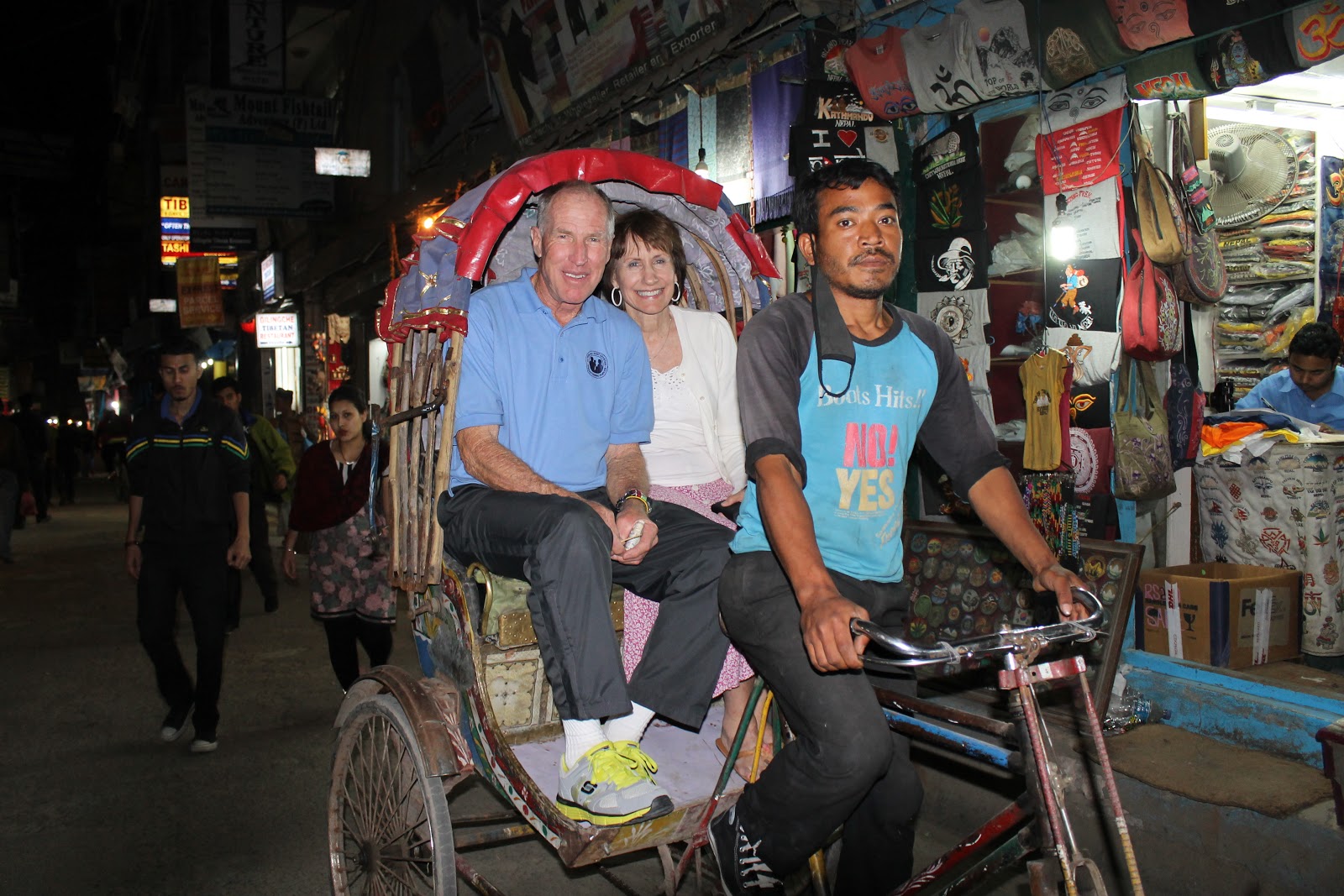
Above & below, it was fun taking a rickshaw!  They don't get as much money as a taxi but they sure work harder on the uneven pavement.


Jim checking on a holding tank below the spring.


We have our tika's and we are ready for a long hike up the rice field 'steps'.


Someone had left a fun piece of equipment at this little school up on the mountain.


The strength of these older women in Nepal is amazing--these bushes are so heavy you can't believe it.


An incredibly beautiful picture taken by Carol Rempp.


Dancing with the little old gentleman who later became my 'hoist' up the ancient rice fields.


At the beginning of one of our hikes to a spring.


Brother of the groom, looking pretty fancy himself.

The beautiful but treacherous Mt. Everest.